
Want to know what defines if AI will take your job?
Why the real threat to your career isn’t the one you’ve been told about, and what a 1960s economist nobody talks about can tell you about where your value is actually going.

I grew up in England, so The Knowledge is something I’ve known about my whole life.
If you’re not familiar, it’s the grueling process London black cab drivers go through to memorise 25,000 streets, every alley, every shortcut, every one-way system in one of the most complex cities on earth. It takes most people three to four years of riding around on a moped with a clipboard, and the dropout rate is enormous. What’s truly wild is that brain scans of cabbies who complete it show their hippocampus, the part of the brain responsible for spatial memory, is physically larger than average. The Knowledge literally reshapes their brains. Forever.
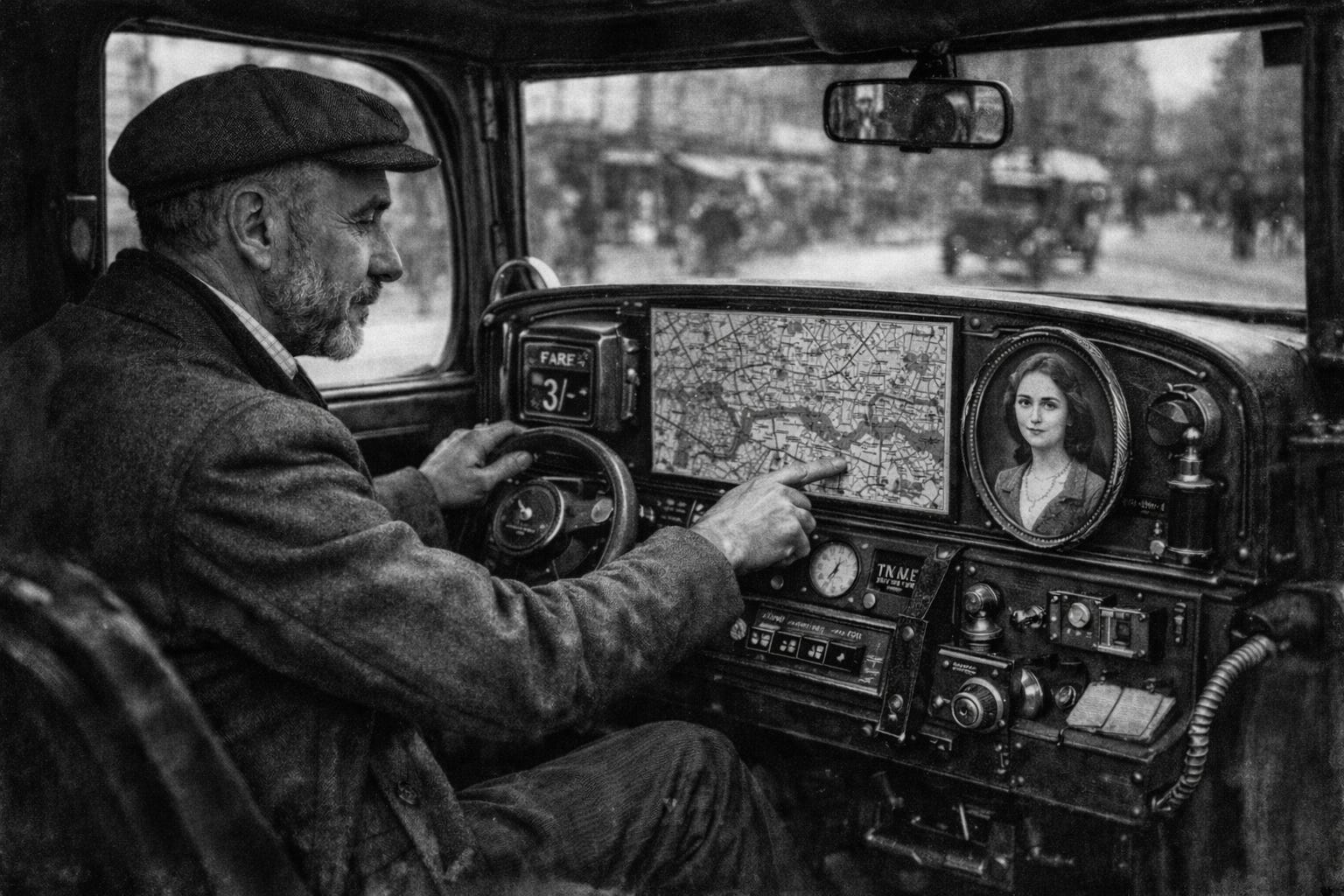
I’ve always found that fascinating, and it made what happened next feel even more brutal. GPS and then Uber automated the expert part, the hard part, the thing that took years to learn and physically altered your brain. Suddenly, anyone with a car and a phone could compete. Employment in ride services went up 250 percent, but wages stayed flat because the hard part was gone, and anyone could do what was left. All those years of preparation, all that accumulated expertise, made redundant by a free app on a smartphone.
That story sits at the heart of something I think most of the AI conversation is getting badly wrong. The question people are asking is “will AI take my job?” and it’s too blunt and too binary to be useful. The question that actually matters is whether AI is taking the hard parts of your job or the easy parts, because those two scenarios lead to completely different outcomes.
We assumed, for a long time, that automation would work its way up from the bottom, taking the routine and repetitive work first and leaving the complex, expert work alone. And for a while, that was largely true. But AI isn’t respecting that old order. It’s coming from the bottom and the top simultaneously, automating the entry-level drudgery and the high-skill expertise at the same time, and increasingly leaving pressure on the people in the middle, the experienced practitioners whose value was always somewhere between pure routine and pure judgment.
To understand where you sit in that picture, it helps to look at what’s already happened to other professions.
When AI takes the hard parts, the expertise evaporates
Stock photo photographers spent years developing an eye, building libraries, and mastering light and composition. Then platforms commoditised the catalogue, and generative AI finished the job. The expertise didn’t become more valuable when automation arrived; it became irrelevant because the machine could produce the output without the craft behind it.
Travel agents carried deep destination knowledge, relationship networks built over careers, years of accumulated understanding about routing and visas and the right hotel for the right traveller. Search engines automated exactly that expertise and left behind a much smaller market of luxury and complex itinerary specialists, serving the clients whose needs still required a human.
Radiologists spent a decade learning to read scans. AI is now matching or exceeding human accuracy on certain image types, pressing directly on the hardest and most trained part of the job. The profession is not disappearing, but the nature of its value is shifting in ways that are genuinely uncomfortable and unresolved.
The cabbie is the clearest version of this story. When the hard part goes, competition floods in, wages flatten, and the years you spent becoming good at something count for far less than they used to.
When AI takes the easy parts, the human judgment becomes more valuable
There is a 1960s economic idea that almost never comes up in the AI conversation, and I think it belongs right at the centre of it. An economist named William Baumol observed that when technology makes some sectors wildly more productive, the sectors it cannot touch tend to get more expensive, not because they got better, but because everything around them got cheaper.
Personal trainers are a good example. Nothing about motivating a human body to move has gotten more efficient. But because everything around fitness got cheaper, the apps, the equipment, the YouTube workouts, the in-person trainer who actually knows you and keeps you honest has become more expensive, not less, because their time became the scarce thing.
Live music tells the same story. Recorded music got infinitely cheap, so the live experience became more valuable than ever. The scarcity shifted.
Skilled tradespeople, plumbers, and electricians, and the people who have to physically show up and solve a problem inside your specific wall, have seen their rates climb steadily for decades while software ate everything around them. AI does nothing to change that trajectory.
And the most interesting emerging version of this might be certain kinds of therapists and executive coaches. AI can now do a reasonable job of reflective listening and structured prompting. But the practitioner who has sat with 2,000 humans over 20 years and can read what someone isn’t saying out loud? That market is pricing upward because the thing AI cannot replicate is becoming the only thing that matters.
The teacher version of this stays with me. AI can teach calculus, probably better than most tutors. But the teacher who notices that a student stopped making eye contact three weeks ago and picks up the phone? That is not a productivity problem. That is a different kind of work entirely, and it is getting more valuable by the month.
The question that now matters most
For most of us working in marketing and business, the honest exercise is to look at last week and ask which parts of your work AI could already handle, and whether those were the parts that took you years to develop or the parts you could teach a new hire on their first morning. Because if AI is absorbing the drudge work and leaving you with the judgment and the relationships and the strategic calls, the economics are moving in your favour. The risk is in standing still while the nature of your value shifts beneath you, assuming that what made you good five years ago is still what makes you valuable today.
The people who come out ahead will be the ones who understand which parts of their work are being commoditised and which are becoming more expensive and more scarce, and who have the honesty and curiosity to keep moving toward the latter.
Dax is the Co-Founder & CEO @ FOMO.ai, and the author of 84Futures.com.
👉 Founder or operator? You can now schedule a 1:1 session with me.