
Forcing function: If the trade war was an audit, China just passed.
The trade war didn't create China's advantage, it just made it impossible to ignore.

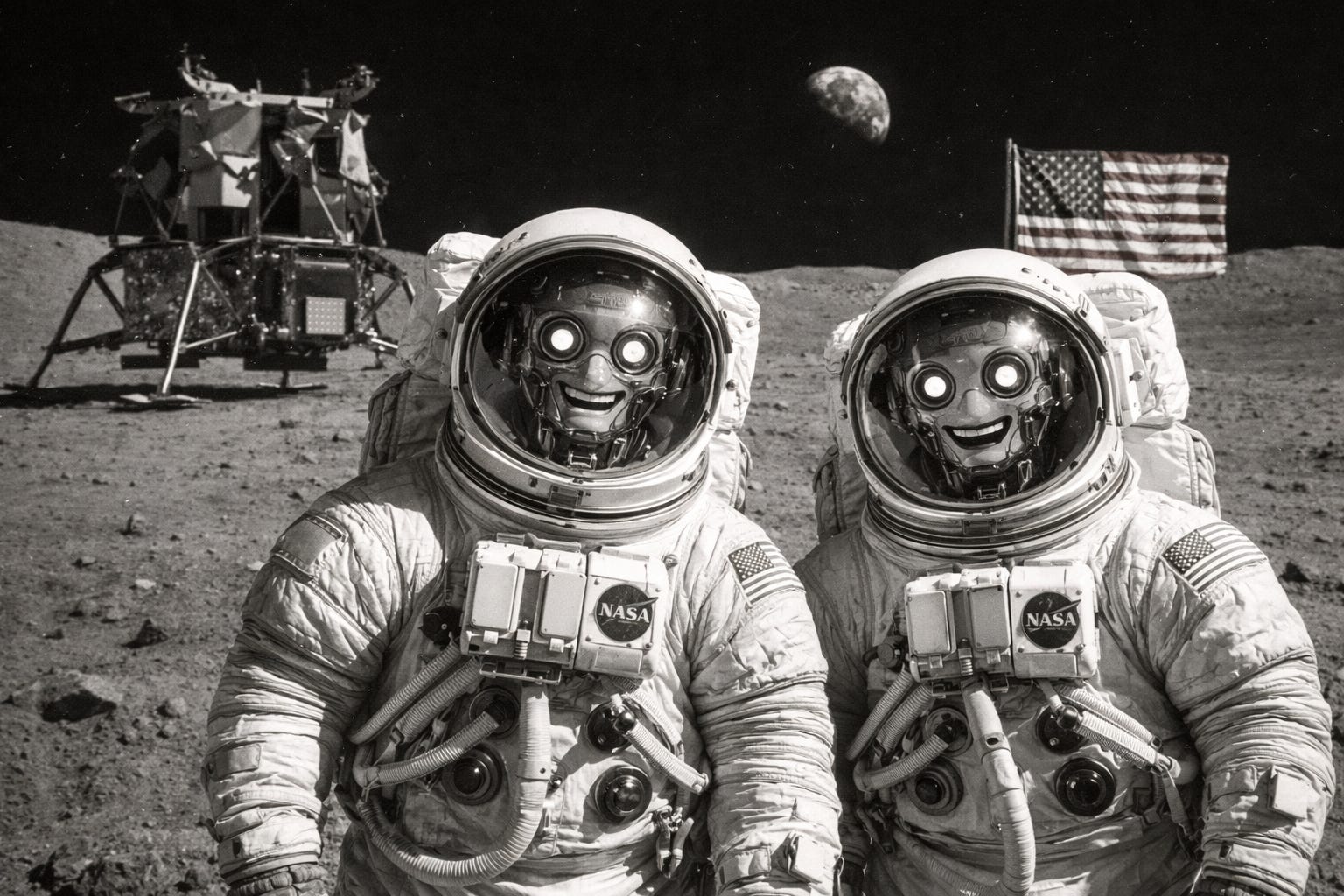
Neil deGrasse Tyson has a line that reframes the space race in one sentence: “We didn’t go to the moon to explore, or because it was in our DNA, or because we’re Americans. We went because we were at war and we felt a threat.”
The moment the Soviet Union made clear it wasn’t going to the moon, America stopped going too. The threat dissolved, and so did the forcing function.
I’ve been thinking about that a lot this week while listening to The Daily’s interview with Keith Bradsher, the NYT’s Beijing bureau chief who has been covering China’s economy since 1991.
The piece is framed as a tariff story, but it isn’t really. It’s more of a story about what happens when you poke something and discover it’s a lot bigger and more solid than you thought.
About a year into Trump’s trade war, China’s overall trade surplus hit $1.2 trillion, bigger than the entire economy of most countries on earth. The tariffs shifted trade away from direct shipping to the US and toward more indirect routes, weakened its currency to make its goods cheaper everywhere else, and kept exporting components indirectly through third countries that assembled them before they reached American shores. The US plan sounded like it was trying to slow their machine, but it seems the machine just found new roads.
And the reason the machine is so hard to stop comes down to something that was years in the making, for reasons that had nothing to do with America at all.
By the mid-2010s, China had a problem. The one-child policy had quietly gutted its future labor supply. Young Chinese workers, the only children of parents who poured everything into their education, were graduating from college in record numbers and had absolutely no interest in factory work. There’s also a deep Confucian tradition that manual work is inferior to intellectual work, and with one child per family, parents weren’t about to let their child spend their life on an assembly line.
Factories were expanding, but bodies weren’t showing up.
So China automated. Not as a strategic flex, but as a survival response. And they did it at a scale and speed that now looks, in hindsight, like a master class. China today installs more industrial robots each year than the entire rest of the world combined. Germany, Japan, the United States — all now have fewer robots per 10,000 manufacturing workers than China. Countries that built their identities around industrial precision were outpaced by a nation that automated out of demographic necessity.
The factories Bradsher visited aren’t just robotic, either; they’re AI-integrated (you knew I was going to bring it back to AI eventually!). Cameras photograph every finished product and compare it with reference databases to flag flaws. AI tracks practically every step of the process. The result is that pretty much anything can now be made less expensively in China than anywhere else, and not just clothing and furniture, but cars, batteries, solar panels, and advanced technology products. The cheap labor narrative feels years out of date, given this is cheap AND advanced.
The tariffs, in other words, arrived at a party that China had already won. And by revealing just how dominant China’s manufacturing base had become, they arguably did more to expose Western industrial decline than to reverse it.
For founders and business owners, I think the lesson here isn’t really about China or tariffs. It’s about what forced necessity produces. China didn’t see automation as an opportunity. It saw it as the only available answer to a problem — no workers, no choice — and it committed completely. The result is a decade-long lead that trade policy alone cannot close.
We’ve built FOMO.ai on exactly this principle, and it’s shaped how we operate more than any strategy session ever has.
We (transparently) sell an idea to a client before we’ve fully solved it.
That commitment creates the forcing function.
The team now has a real problem, a real client, and a real deadline
What comes out the other side is invariably better than anything we would have built in a vacuum, whether it be a new process, a new product, or new learning that we carry into everything that follows. The discomfort of the commitment is the point! It’s what stops you from endlessly refining something in theory and never shipping it in reality.
China did this at a national scale. The one-child policy created a crisis, the crisis created a forcing function, and the forcing function produced the most automated manufacturing base on earth. They didn’t plan to be decades ahead; they allowed themselves to be pushed there.
The question worth sitting with is: what is your forcing function going to be? Because if you wait for the threat to arrive before you start building, whether that’s a competitor, a market shift, or a client you’ve already promised something to, you’ll be in the same position as the countries staring at China’s trade surplus right now. Technically still in the game, but playing catch-up on a lead that was built years before the pressure arrived.
Dax is the Co-Founder & CEO @ FOMO.ai, and the author of 84Futures.com.
👉 Founder or operator? You can now schedule a 1:1 session with me.