
AI doesn't fix bad Founders, and Meta will charge you to find out
Our Meta relaunch this month was a lesson in why AI amplifies whatever you give it, including the broken parts.

Meta’s pitch to advertisers in 2026 reads like a fever dream.
Hand over your budget, your credit card, and a couple of ad assets, and the algorithm will find your customers for you. Don’t worry about targeting, audiences, or even too much about the creative, because the system learns.
It’s a seductive promise because it sounds like the broader AI promise applied to the most painful part of running a company, which is the bit where you have to figure out who your customer actually is and how to reach them.
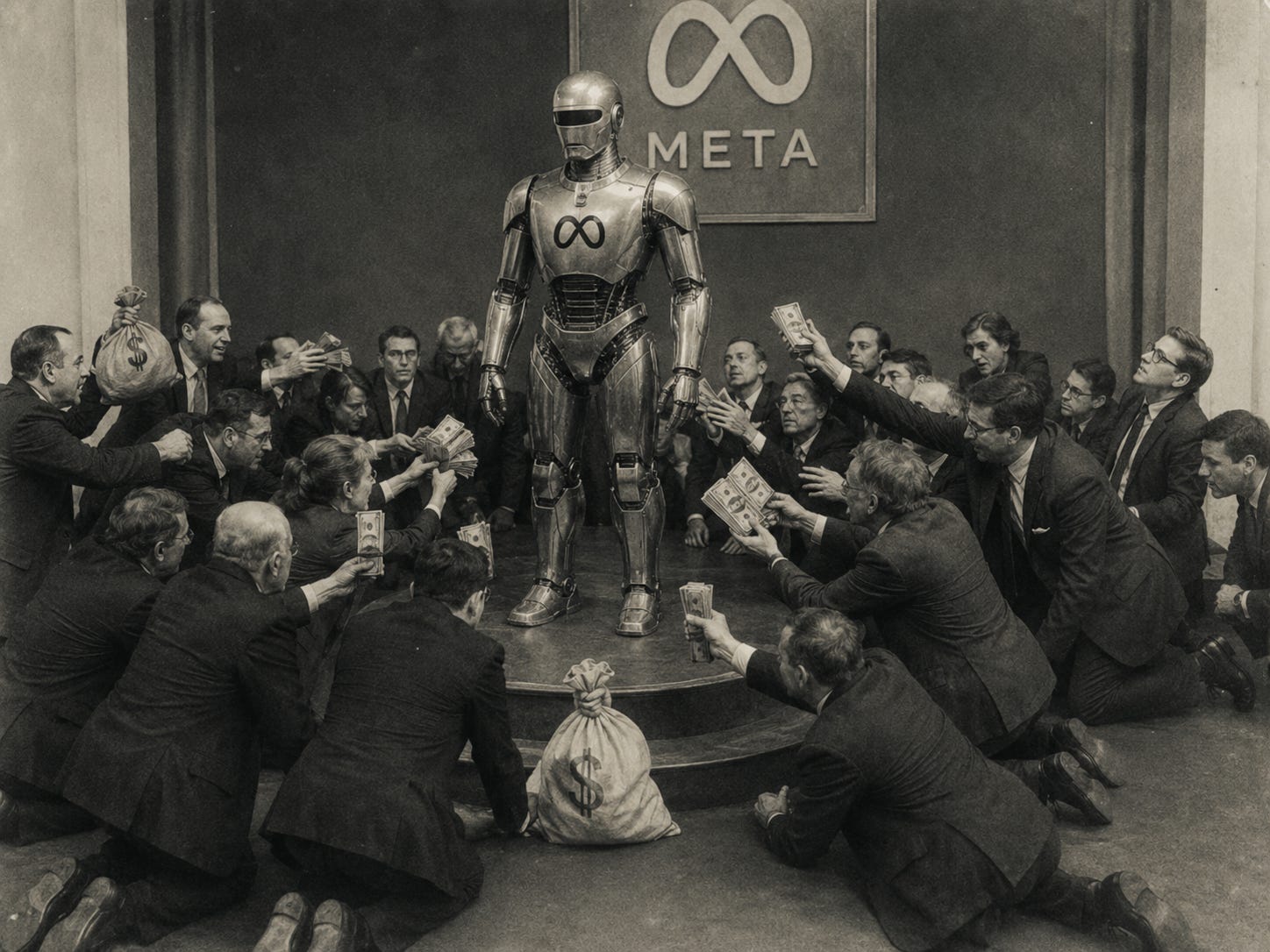
What every founder secretly hopes for is a system that handles the hard work in the background while they focus on the product, and Meta is telling you that system finally exists.
Google’s Performance Max tells you the same thing, ChatGPT tells you the same thing, and the whole AI tooling layer right now is built on a single underlying idea, which is that you can skip the thinking. You can’t, of course, and the founders who believe you can are paying a lot of money to find that out.
At FOMO.ai, we relaunched our Meta campaigns this month, and the journey through our own numbers over the past few quarters has been a refresher of how quickly this is all changing.
Q4 last year, we got cost per booked call down to as low as $110, which by most standard metrics looked like a meaningful win, but who showed up to those calls was a problem, including no shows and people who weren’t our ICP, etc We rebuilt the campaigns in Q1, and CPL went up to $235, with volume dropping at the same time, but the calls themselves were noticeably better. Real prospects with real budget, the kind that actually close.
Over the last month, we ran a different experiment, putting two agencies in parallel, both on clean pixels, both pointed at the same ICP and the same offer, but with full creative control over messaging.
One came back with a very high cost per click and almost no bookings to show for the spend. The other came back with bookings around the $210 mark, all good quality, the kind of pipeline that actually closes. Same platform, same product, same week, completely different outcomes, and the variable wasn’t Meta. Meta was doing exactly what Meta does in all four scenarios. The variable was the work done before spending began.
This is what nobody seems willing to say out loud about the current generation of AI ad platforms. They are amplifiers rather than marketers, and they take whatever signal you give them and multiply it.
Part of that signal will be elements of your ICP that aren’t given enough thought, things like:
What’s keeping them up at night?
What’s their short-term goal?
What’s the goal that is transformational for them?
How do they talk about their problems and opportunities?
If your ICP definition is sharp, these platforms multiply that. If your copy speaks your customer’s language, they multiply that, and if your follow-up infrastructure is built for the actual buying behavior of your audience, they multiply that too. And if any of those things are weak or missing, they multiply that just as efficiently, only faster and more expensively than the old platforms ever did.
The Meta pitch quietly skips this part. It’s structured to sell you on a world where you don’t need to know who your customer is because the algorithm will figure it out, but the algorithm is figuring out who responds to your ad, which is a fundamentally different thing from who your right customer is. If your creative is pitched at the wrong person, Meta will obediently find more of the wrong person, cheaply, at scale, and forever if you let it.
Two specific things we changed in the relaunch turned out to matter more than anything else, and both of them were the unglamorous foundational work that the platform pitch implies you can skip.
The first was putting our actual price in the ad. Our standardized service is $2,750-$3,500 a month (which replaces what would typically be a $10,000-a-month agency engagement), and the conventional wisdom on paid social is that you hide the price to maximize the click rate. That advice is a hangover from a world where cost per click was the metric that mattered. In a world where the metric is cost per closed customer, you actually want the price to do the filtering before someone books. The click volume went down as a result, but the bookings got dramatically better, because Meta’s algorithm started finding people who had budget and were genuinely shopping, partly because we’d told it (and them) what we cost. The platform amplified that signal, and the signal was now a productive one.
The second thing we changed was building follow-ups that were more fitting. Our price point sits in a particular zone where it’s not low enough to be a snap purchase, but not high enough to require a procurement process either, which puts it squarely in the “let me think about that and come back to it” zone. Most founders treat paid social as a closed loop, where the ad goes out, the click comes in, and the booking either happens or it doesn’t. But for our price point, the booking is just the first signal of intent, and what happens in the seventy-two hours after the booking is where the deal actually gets made. If your follow-up sequence is generic or your team isn’t reading the signal properly, Meta will keep delivering bookings that don’t close, and you will keep paying for them indefinitely.
My friend Amy (Fortune 500 CMO) taught me a question years ago that I keep coming back to, and it applies here more than almost anywhere. When you’re trying to figure out how to talk about your product, ask your existing customers how they would describe what you do to a friend, colleague, or family member. The answers are almost never the words you’d use yourself, because they cut through the Founder vocabulary and the category jargon and land on what the customer actually thinks they’re buying. That language is the copy you should be running on Meta, on Google, in your follow-up emails, and on your landing pages, and it’s also the language Meta’s algorithm will pick up and amplify if you give it.
Most founders write ad copy in founder language. They explain the product the way they’d pitch a VC, and the customer doesn’t think that way, because the customer is trying to solve a specific problem in their week. The ad that wins is the one that uses their words to describe their problem and their version of the solution, and that is an ICP exercise, a copywriting exercise, and a customer research exercise rolled into one. It is the core of the work, and AI doesn’t do that work for you. It can help once you’ve done it, by writing variants, testing combinations, and scaling what already works, but the inputs have to come from somewhere, and that somewhere is still you, still on the phone with your customers, still asking Amy’s question.
Great example. Our core solution is currently named Done For You… made sense when we listed Do It Yourself and Done For You, but with DIY moved to a different ICP, it becomes nonsensical. With the speed we run at as Founders, sometimes it takes a customer conversation to see the obvious.
This is the part that connects back to the bigger argument.
We are in a moment where the AI tooling layer is selling a version of business-building where the founder doesn’t have to do the foundational thinking. The agent will, the model will, the platform will, and there’s a kernel of truth in it. AI genuinely is doing things that used to require a team, but the work it’s doing well is execution work rather than judgment work, and amplification work rather than foundation work.
Distribution is foundation work, knowing your customer is foundation work, pricing for the right segment is foundation work, and building follow-up that matches the buying psychology of your audience is foundation work.
None of it is being done by Meta or Google or ChatGPT, even though all three of them imply they’re doing it for you. They’re doing the part that comes after. The part that comes before is still your job, and right now it is more important than it’s ever been, because the amplifier itself is more powerful than it’s ever been.
If you give a powerful amplifier a weak signal, you don’t get a clearer signal back, you get a louder version of the same weak thing, and in a paid media context, louder means more expensive. The Founders who are doing well on Meta right now are not the ones who hit some magic creative formula or stumbled onto a clever targeting trick, they’re the ones who did the unglamorous work of figuring out exactly who they’re for, exactly what those people are trying to solve, exactly what language those people use, and exactly what has to happen after the click for the booking to actually convert. Then they handed all of that to Meta, and Meta amplified it cleanly.
I keep thinking about how this maps onto the broader AI conversation. Everyone is asking whether AI will replace this job or that job, but the more useful question right now is what AI is amplifying, and whether the thing being amplified is any good in the first place.
Confidence isn’t correctness, a campaign that’s spending isn’t a campaign that’s working, and an AI output that sounds polished isn’t an AI output that’s right. The platforms have gotten very good at producing things that look like answers, but determining whether the answer is actually correct and whether the underlying inputs were any good to begin with is still entirely on you.
That has always been the hard part, and AI hasn’t removed it.
Dax is the Co-Founder & CEO @ FOMO.ai, and the author of 84Futures.com.
👉 Founder or operator? You can now schedule a 1:1 session with me.